
Power derating in industrial automation
Power derating in industrial automation
This article analyzes the various factors that necessitate power supply derating, and how derating can improve the reliability of industrial power supplies and extend the mean time between failures (MTBF).
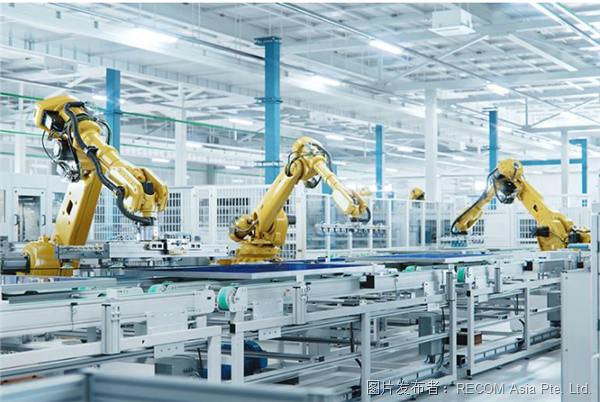
Dermination of industrial power supplies
The rated power of a power supply refers to the maximum wattage that the device can output under standard operating conditions. For example, a power supply might be labeled as a "480W power supply" or a "15W DC/DC converter." However, this rated power is limited by operating conditions. External conditions such as excessively high or low ambient temperatures, low input voltage, and high operating altitude will reduce the maximum continuous output power of the power supply. To cope with these conditions, the power supply's output load needs to be reduced; this operation is called derating. Derating reduces the power supply's internal power consumption and heat generation, ensuring stable operation throughout the product's lifespan, thereby achieving reliable operation and extending equipment life. An industry-standard guideline is that for every 10°C increase in ambient temperature, the equipment's lifespan is halved.
Parameter specifications and their effects
Power supply manufacturers typically provide derating requirements using graphs or formulas. RECOM provides derating curves for both temperature and input voltage, along with percentage derating factors that increase with altitude, and may also set absolute load limits when necessary.
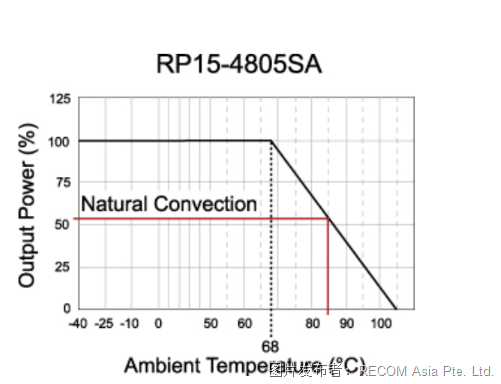
Figure 1: Typical derating curves, showing the relationship between maximum rated output power and ambient temperature.
The temperature derating curve shows the ambient temperature on the X-axis and the output power on the Y-axis. When the ambient temperature rises, the output power must be reduced to prevent the power supply from overheating; this requires derating.
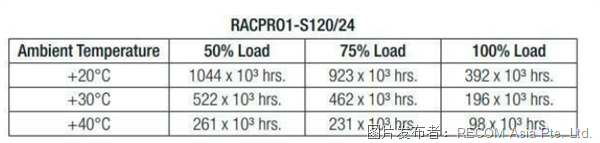
Table 1: Impact of Derating on Power Supply Lifespan and Reliability
Common misconceptions about design margins
Power supply specifications typically include a certain margin to withstand load inrush current, input voltage surges, and transient voltages. However, when selecting a power supply, the absolute maximum value should not be used as the normal operating condition. This margin represents the product's design robustness and is only intended to cope with short-term abnormal operating conditions; the absolute maximum value should not be used as an indicator of actual operating performance over a long period.
Looking up and interpreting the reduction curve
RECOM industrial automation power supplies have their derating profiles listed at the end of the product datasheet; other manufacturers may place their derating profiles in application notes or separate reference documents.
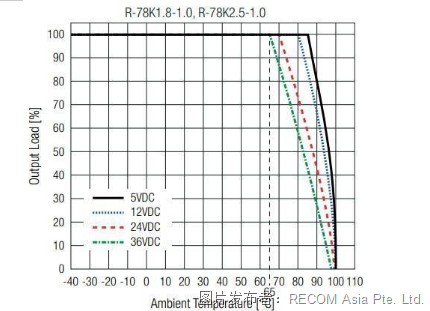
Figure 2: Derating curves that simultaneously include load, ambient temperature, and input voltage (RECOM R 78K1.8 1.0, R 78K2.5 1.0)
Figure 2 shows multiple derating curves for the wide-input switching regulator (R78K series) at different input voltages. The efficiency of the switching regulator decreases as the input voltage increases, and the device reaches its load limit more quickly. Therefore, under high input voltage conditions, the derating start-up temperature will be lower.
In this example, with an input of 5V and an output of 2.5V, the power consumption of the entire unit is very small, the converter has almost no thermal stress, and it can still output full power even when the ambient temperature is as high as 85℃; however, with the same load, if the input voltage is 36V, the derating must begin when the temperature reaches 65℃.
RECOM publishes reliability data in its product manuals. The R 78K1.8 1.0 series switching regulators shown in Figure 2 have an MTBF of 5139 × 10³ hours at 25°C, according to MIL HDBK 217F standard; the MTBF range for models R 78K2.5 1.0 to R 78K15 1.0 is 4990 × 10³ to 4546 × 10³ hours.
Multi-factor derating in power supply applications
Internal heat generation is the primary consideration for derating, but it's not the only one. Increased altitude and thinner air reduce heat dissipation, also triggering derating. High altitude combined with high input voltage further compresses the thermal margin, making the derating curve's downward slope even steeper.
Key environmental and electrical derating factors
Ambient temperature
Working altitude
• Input voltage (voltage level, AC/DC type)
• Load type (capacitive, inductive, dynamic load, resistive load)
Ventilation conditions
Altitude derating requirements will be specified in the manual in the form of charts or text. Taking the R 78K 1.0 series switching regulator as an example, the RECOM manual's "Environmental Conditions" section indicates a maximum operating altitude of 5000 meters. Derating should begin when the altitude exceeds 2000 meters. Within the 2000-5000 meter range, the maximum output power decreases by 5% for every 1000 meters increase in altitude. Altitude derating needs to be calculated in conjunction with temperature derating.
Derating and peak power
Highly capacitive loads such as motor drivers and charging circuits generate large inrush currents upon power-up, lasting from a few milliseconds to tens of milliseconds, with surge amplitudes reaching 10 to 50 times the steady-state current. The power supply must withstand these surges without triggering overcurrent protection, while also being able to respond normally to short-circuit faults.
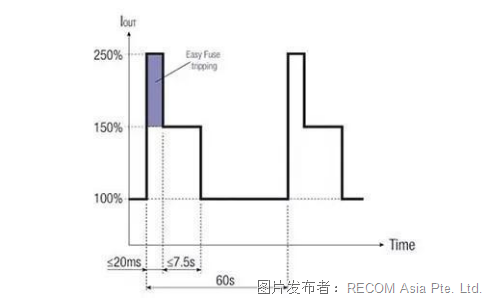
Figure 3: Peak load duration versus cycle curve for RECOM RACPRO1 T480 rail power supply. All percentages in the figure are values after derating.
The image above shows the overcurrent capability of the RECOM rail-mounted power supply (RACPRO1 T480 series). The power supply can withstand 100% of its rated load continuously; it can withstand up to 150% of its rated current for short periods, but the duration of any single event cannot exceed 7.5 seconds, and the interval between two events must be at least 60 seconds. In the event of a short circuit on the output side, the power supply can output up to 250% of its rated current for 20 milliseconds, ensuring reliable blowing of the output circuit fuse.
Ventilation and heat sink
Most industrial power supplies are installed inside enclosed cabinets , which may or may not have forced ventilation. Forced air cooling can lead to dust accumulation and often fails to achieve the desired heat dissipation effect.
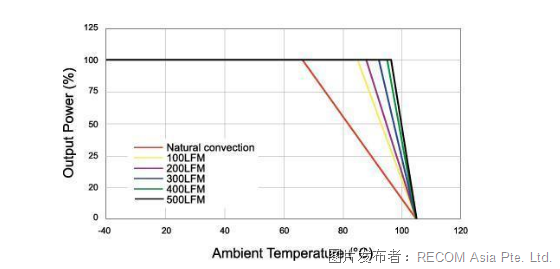
Figure 4: Output power temperature derating curves under different wind speeds
Figure 4 shows a typical derating curve, illustrating the impact of cooling airflow. Without ventilation, derating begins at approximately 67°C; with forced airflow at 100 feet per minute (LFM), the derating initiation temperature rises to approximately 85°C. Further increasing the airflow yields significantly diminishing returns; at 500 feet per minute, the derating initiation temperature only rises to approximately 95°C.
The actual limit of reduction
Derating is not unlimited. Once the temperature exceeds a certain threshold, no amount of derating can guarantee safe operation. When the load approaches zero, the power supply's efficiency also decreases. This characteristic, combined with the risks posed by high-temperature environments, leads to a situation where, in high-temperature and high-altitude scenarios, power reduction can only provide partial relief, or even be completely ineffective.
What are the differences between AC/DC power supplies and DC/DC power supplies in terms of derating?
The core difference between the two is that AC/DC power supply derating must take into account the additional thermal and electrical stress brought about by the front-end rectifier circuit and power factor correction (PFC), while also dealing with a wider range of input voltages; DC/DC power supply derating mainly considers local thermal management and operating altitude.
The fundamental considerations for AC/DC converters are largely the same as those for DC/DC converters. However, AC inductive loads present unique risks: power factor lag (voltage and current phase shift) under heavy load conditions, and the generation of back electromotive force when the load is turned off. Both of these situations can potentially push the power supply beyond its operating limits. RECOM's AC/DC power supplies are specifically designed to address these typical AC load issues, featuring strong surge current withstand capability and the ability to withstand high reverse voltages.
Summary and extended materials
When designing industrial automation systems, power supply derating is a crucial aspect that cannot be ignored. Derating ensures that the power supply outputs stable and sufficient power throughout the equipment's lifespan, preventing harsh environments and operating conditions from significantly shortening the power supply's lifespan and reducing the risk of premature power supply failure and downtime. Derating curves and calculation formulas provide important guidance for power supply and component selection.
The RECOM Knowledge Base and blog contain a wealth of technical information related to power supply applications and design. The RECOM AC/DC Knowledge Handbook, DC/DC Knowledge Handbook, and EMC Knowledge Handbook series comprehensively introduce knowledge related to power supplies and power converters.
 Implicit Collaboration Capabil
 Changes in device connection m
 LVDT displacement sensor defor
 LVDT Displacement Sensor Mater